by Adrihani Rashid
Oroo, an intricate forest sign language crafted from rainforest materials, encapsulates the Penan’s worldview and ecological knowledge system. Its rapid decline in parallel to the loss of forests and biodiversity puts Penan culture and knowledge systems at risk. Sustainable tourism, where grounded in community leadership and respect, could offer a path to revitalise Oroo.
Malaysian youth who were once Pengakap (scouts) might recall learning about isyarat sulit (secret signs)—little twig signs and trail markers left along forest paths to show direction, signal danger, or call for help. Knowing this “secret language” made us feel safe in the jungle, confident we could communicate with our fellow scouts without saying a word.
In the depths of the Sarawak rainforest, the Indigenous Penan take this to a completely different level. Their forest sign language system, called Oroo, is not merely a set of symbols but a deeply sophisticated, memory-rich, object-based language—a way of reading and writing the forest itself.
Encoding the Penan worldview
Oroo is a language made from the materials of the rainforest: bent twigs, folded leaves, carved notches, fronds tucked into a bark slit; or elaborate arrangements fixed to a signage stick known as Batang Oroo. Each sign conveys meaning through form, placement, material choice, orientation, and combination rules (Zaman et al. 2015; Plimmer et al. 2015).
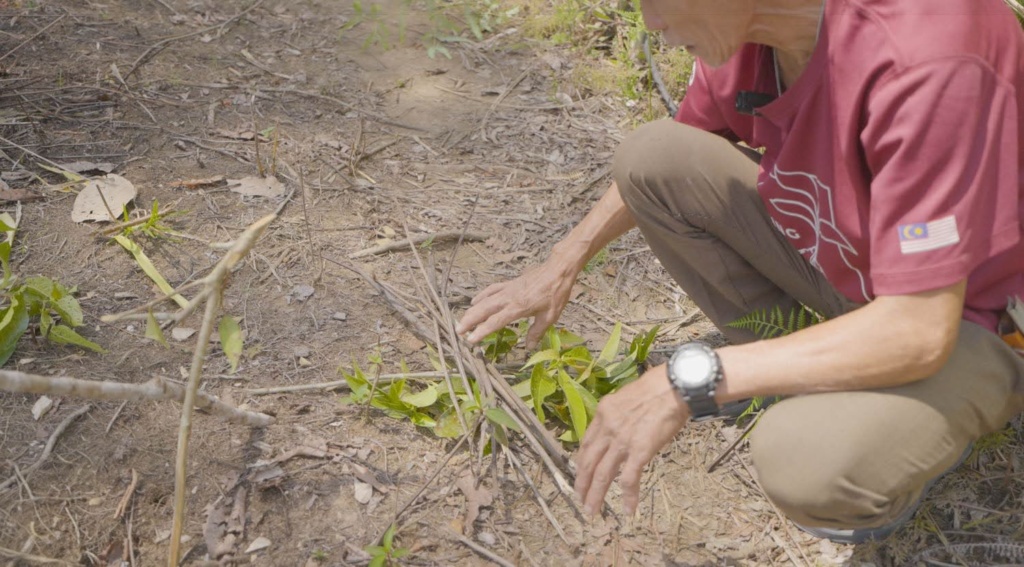
Seman Adun of Long Kerong demonstrating oroo. Photo by Small Towns MY
Unlike the simplified scouting signals, Oroo communicate complex concepts, including direction of travel, food availability (to the level of detail of sago, game, or fish), danger warnings (including predators, hostile presence, hazardous terrain), emotional states (such as “we are well”, or “we are troubled”), requests for help, anticipated times of return, and even detailed narratives of multi-day journeys into the forest that the Penan call toro.
It is a functional communication system used across time and space, especially when groups travel separately through vast forest territories. This was especially critical in earlier times when most Penan practised a nomadic lifestyle, moving cyclically through the land, leaving marks and messages for those who would follow. Oroo serves as an asynchronous communication system that ensures safety, cohesion, and orientation (Rothstein 2020); allowing families to follow each other’s routes with precision through dense, shifting forest.
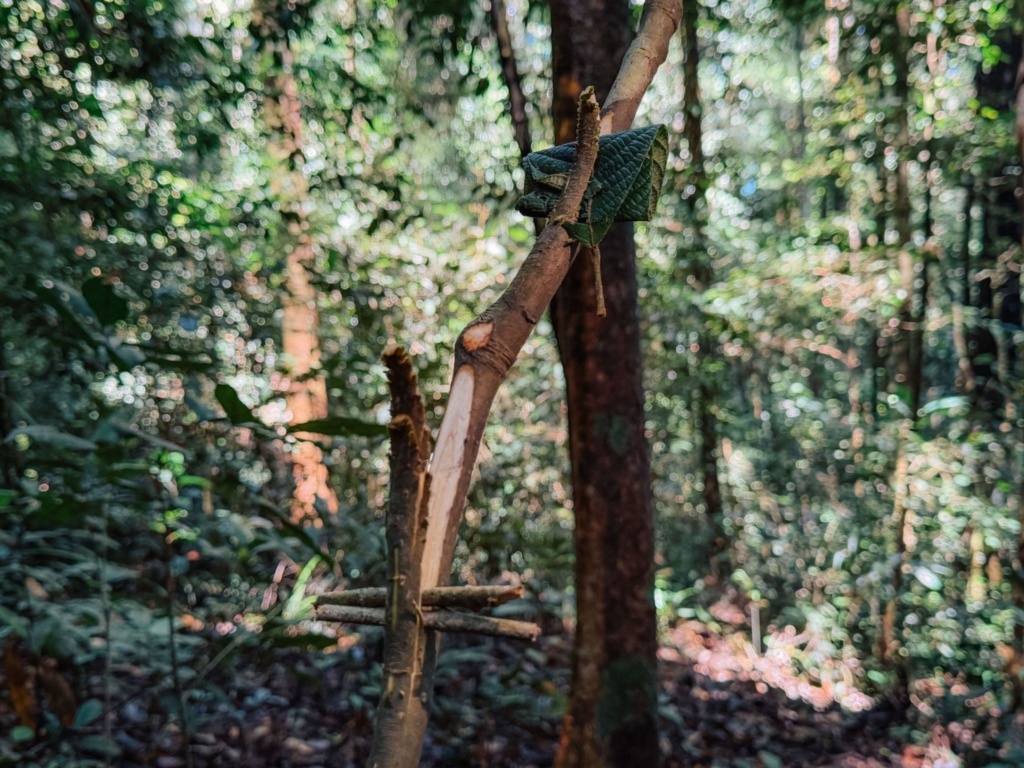
An example of a simple message in oroo – we are friends, here is some food that you can eat. Photo by Adrihani Rashid
Critically, Oroo encodes far more than geography. It reinforces values such as stewardship, sharing, care, and mutual responsibility central to Penan egalitarian ethics. A sign saying “I left food for you” is as much a cultural message as a logistical one. Oroo is also used to mark plants that are under molong—a Penan concept of sustainable resource management that not just lays claim to a resource, but more importantly fosters it for the future (Langub 2023). As Rothstein (2020) describes, Penan cosmology does not separate “people” from “nature”; instead, humans, animals, spirits, and landscape together form tana’—the forest-world. Oroo operates within this relational worldview as one of the semiotic threads binding people to place.
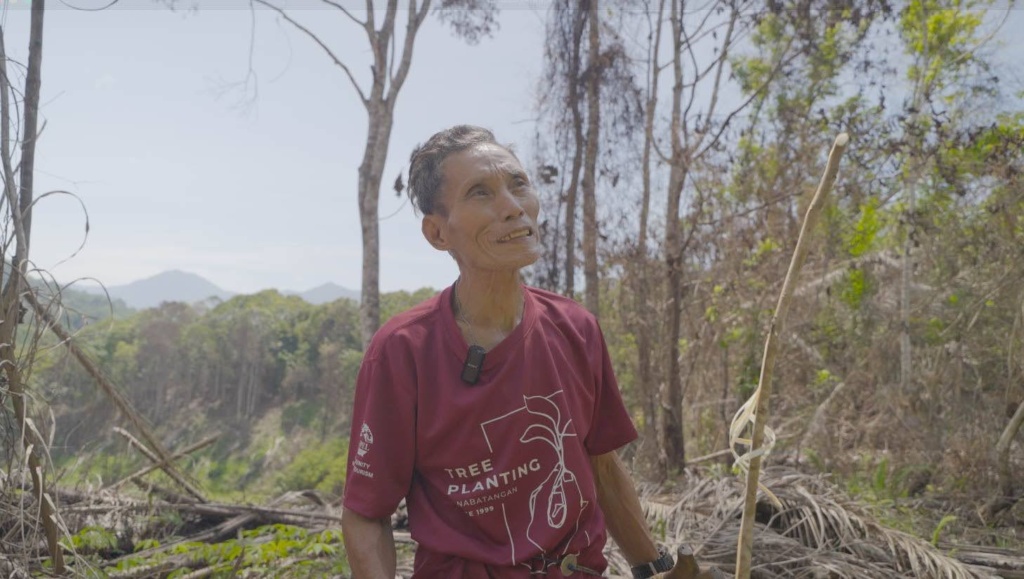
Seman Adun of Long Kerong sharing his knowledge of various oroo that are fading from regular use. Photo by Small Towns MY
To be adept in Oroo requires a deep understanding of the rainforest environment and the Penan ecological knowledge system. An individual must be able to recognise different plant species, understand seasonal weather cycles and animal behaviour, and grasp concepts from hydrology, watershed dynamics, landscape features, and microhabitats. Penan identity is intricately linked to the land in which they inhabit, and the intimate knowledge of everything within it is critical to the use of Oroo. Oroo is not a symbolic language about the forest—it is a language of the forest.
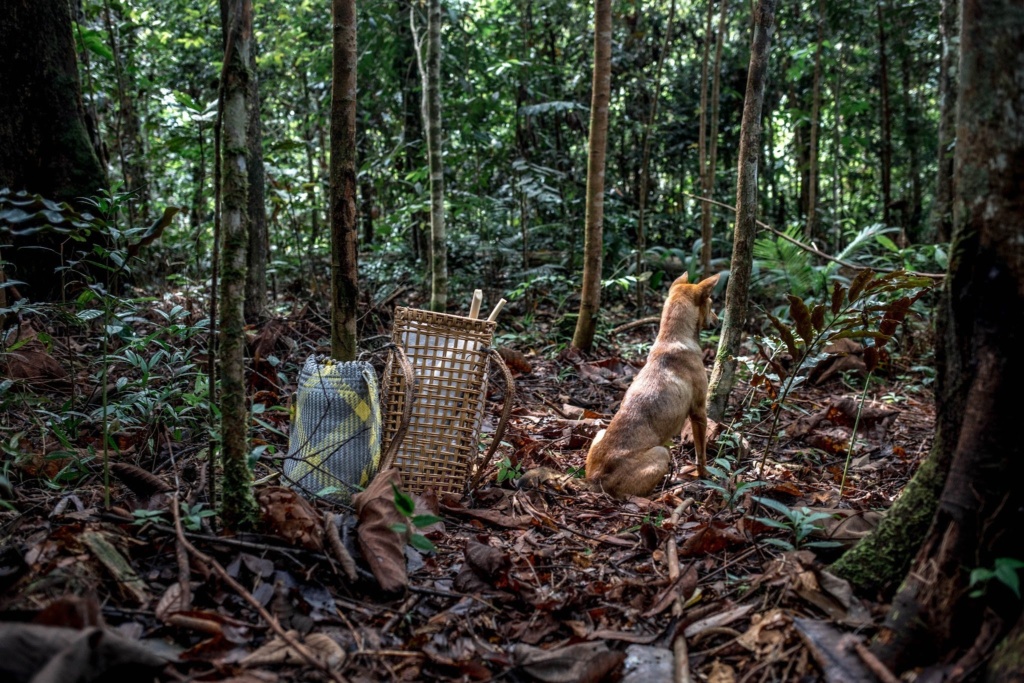
A typical Orang Ulu jungle kit – handcrafted bags and baskets, a parang, and a trusty companion. Photo by Adrihani Rashid
Parallel losses
As the world’s biological diversity shrinks, so too do Indigenous languages and cultures that evolved alongside these landscapes; threatened by unsustainable development, cultural homogenisation, and urban expansion. Across Penan settlements, elders express concern that young people now know only a handful of signs, if any (Zaman et al. 2015; Ibrahim et al. 2021). Research in Long Lamai shows elders recalling 50–55 common signs, yet individuals under 20 often recognise fewer than five.
This is a decline woven from many threads: homes that no longer move with the seasons, lessons learned in classrooms instead of on toro, forests thinned by logging and replaced by land conversion, the soft glow of smartphones replacing the forest’s own language, and a generation that no longer walks alone beneath the canopy where Oroo once lived in every step. This is not to say that development is undesirable, but that it often brings unintended consequences in the rush to move forward. Untold numbers of plant and animal species may already have gone extinct before science even had a chance to describe them (Kew 2023; Tedesco et al. 2014).
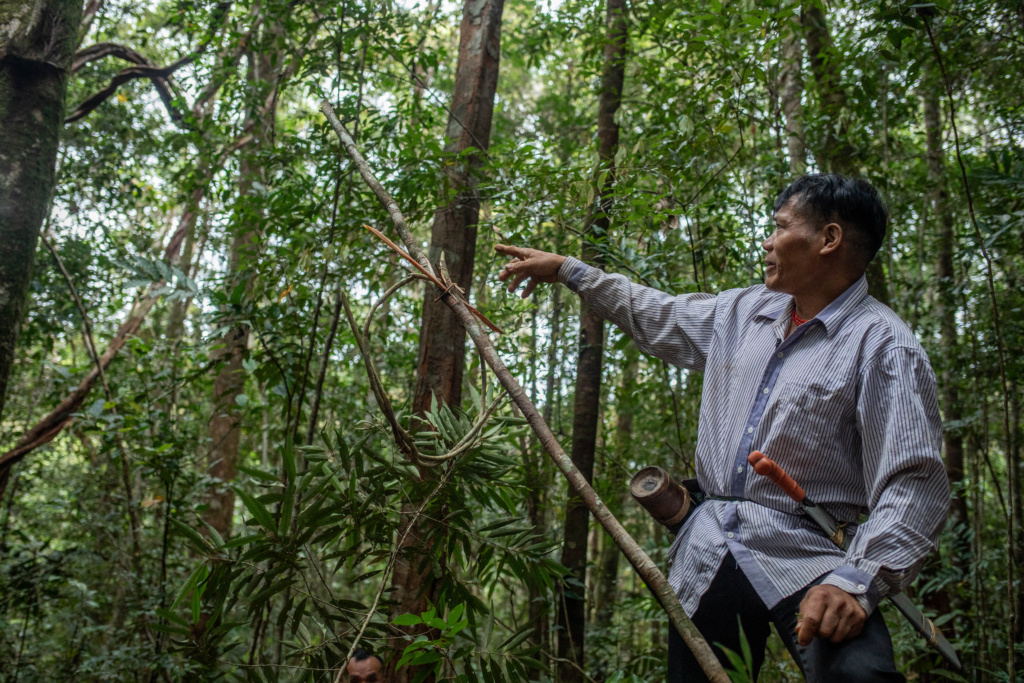
Péng Megut of Long Tevenga. Hunting parties often travel at different paces, and oroo is a means of leaving messages for those who are further behind. Photo by Adrihani Rashid
Once a sign falls out of use, its cultural, ecological, and social meaning diminishes. When this happens, both culture and environment can end up being sacrificed on the altar of development, lost to mankind forever.
Studies reveal a powerful convergence: regions richest in species are also home to the greatest diversity of Indigenous languages, suggesting deep co-evolution between ecosystems and the cultures within them (Maffi 2001; Gorenflo et al. 2012). Today, as species disappear at rates up to a thousand times the historical norm and linguists predict that 50–90% of the world’s languages may fall silent by the end of the century, the parallel crises of biodiversity loss and linguistic loss are unfolding side by side (Sutherland 2003; Gorenflo et al. 2012).
For the Penan, logging and deforestation have altered familiar landmarks, water patterns, and forest structure, making some Oroo signs less interpretable or relevant (Langub 2023). Meanwhile, the loss of wild sago, key trees, and animal populations removes the referents of many signs (Brosius 1999; Rothstein 2020). As ecological niches collapse, so too does the vocabulary anchored within them. The biological landscape is the text, and Oroo is the reading system. When one disappears, the other becomes unreadable.
If Oroo were to disappear, the loss would reverberate far beyond the fading of a forest sign language. It would mean the erosion of an embodied way of knowing the rainforest: of perceiving movement, sound, texture, and meaning that has guided generations of Penan over centuries. Without Oroo, young Penan lose a structured framework for interpreting the forest where ecological cues, seasonal changes, and subtle patterns transform into knowledge. Its disappearance would also fray the threads that tie the Penan to their nomadic past, a history not recorded in books but inscribed along trails, riverbanks, fruiting trees, and ancestral campsites.
Oroo has long served as a quiet map of belonging, encoding where families travelled, gathered sago, hunted, and lived. Without it, the cultural evidence of continuity—the proof of a people’s long and intimate relationship with their land—weakens. And with elders now holding the largest share of Oroo knowledge, its loss would mark a profound rupture in intergenerational transmission, leaving a rising generation without a crucial inheritance. This is why Penan communities speak urgently about the need to preserve Oroo: it is not merely a system of signs, but a way of being in the forest, a living thread connecting person, place, and memory.
Supporting Oroo through sustainable tourism
Sustainable tourism, when done poorly, can flatten cultural nuance or turn living traditions into commodities. But when rooted in community leadership, cultural sensitivity, and long-term partnership, it can become a powerful ally. Tourism can create conditions for Oroo to be practised, taught, and valued again. Community-guided interpretive walks allow elders and youth to share selected, non-sensitive signs while restoring forest-based learning and generating income. Revenue from tourism can support the quiet but vital work of cultural transmission—stipends for elders who teach Oroo, toro camps for youth, community-led documentation efforts, and training for young Penan as guides and cultural custodians (Zaman et al. 2015; Ibrahim et al. 2023).
Ethical visitor protocols developed by Penan communities (Goagoses et al. 2019) help ensure that tourism takes place with consent and respect. Meanwhile, visitors who arrive with curiosity and humility can help reinforce pride among Penan youth, demonstrating that Oroo is not a relic but a sophisticated and highly valued Indigenous knowledge system. Digital heritage projects such as the Oroo Adventure Game and tangible learning tools co-created with Penan communities have also shown promise in reconnecting youth with their heritage, and tourism-linked funding can help sustain such innovations (Plimmer et al. 2015).
In this way, sustainable tourism becomes more than just an industry; it becomes a platform for cultural renewal, helping ensure that Oroo remains a living language of the rainforest rather than a memory of what once was.
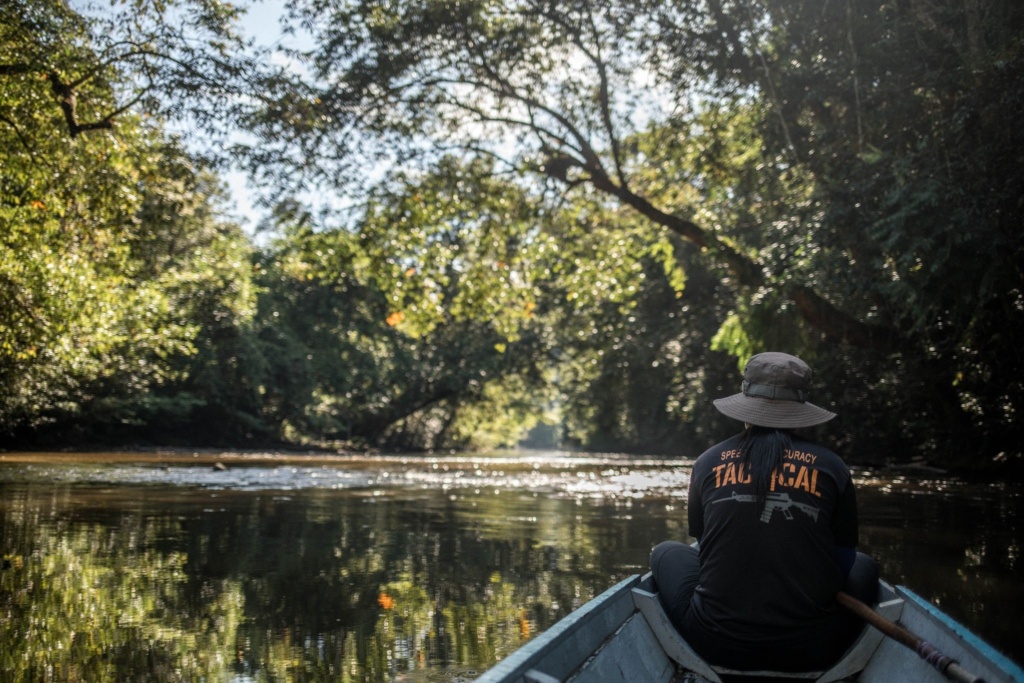
Selungo River, one of the heartlands of the Penan community. Photo by Adrihani Rashid
As readers and travellers, we each hold a small but meaningful part in ensuring that Oroo, and the culture it expresses, endures. You can begin by learning about Penan history, forest knowledge, and cultural resilience; and approaching their stories with humility and respect. Support Penan-led sustainable tourism initiatives, where income flows directly to communities and where elders and youth share their heritage on their own terms. Choose products and experiences that uplift local livelihoods, and back organisations working to secure Indigenous land rights and culturally grounded development. Most importantly, recognise that Borneo’s forests are not only biodiversity strongholds but cultural homelands. Standing behind efforts that protect both people and forests—and honouring Indigenous knowledge rather than consuming it—will help ensure that Oroo remains a living language spoken by the rainforest and its people.
References
Brosius, J.P. (1999). ‘Anthropological engagements with environmentalism’. Current Anthropology, 40(3), pp.351–377.
Goagoses, N., Zaman, T., Winschiers-Theophilus, H. & Kapuire, G. (2019). Community Protocols for Researchers Working with Indigenous Communities. UNIMAS.
Gorenflo, L.J., Romaine, S., Mittermeier, R.A. & Walker-Painemilla, K. (2012). ‘Co-occurrence of linguistic and biological diversity in biodiversity hotspots and high biodiversity wilderness areas’. Proceedings of the National Academy of Sciences, 109(21), pp.8032–8037.
Ibrahim, M.S.N. et al. (2021). ‘Perception on Penan’s Oroo’ Language among Local Community at Batu Bungan’. Yasawi University Bulletin, 4(122), pp.27–36.
Ibrahim, M.S.N. et al. (2023). ‘Community well-being dimensions in Gunung Mulu National Park’. Humanities and Social Sciences Communications, 10, 226.
Langub, J. (2023). ‘State of Belonging: Engaging the State in Borneo’. Journal of Borneo-Kalimantan, 9(2), pp.77–92.
Maffi, L. (2001). ‘On the interdependence of biological and cultural diversity’. In L. Maffi (ed.) On Biocultural Diversity: Linking Language, Knowledge, and the Environment. Smithsonian Institution Press.
Plimmer, B. et al. (2015). ‘New Interaction Tools for Preserving an Old Language’. CHI 2015 Proceedings, pp.1–10.
Rothstein, M. (2020). ‘Being Lost: Landscape, troubling spirits and ritual strategies among the Eastern Penan’. Hunter Gatherer Research, 4(3), pp.355–371.
Royal Botanic Gardens, Kew (2023). State of the World’s Plants and Fungi 2023. Richmond, UK: Royal Botanic Gardens, Kew.
Sutherland, W.J. (2003). ‘Parallel extinction risk and global distribution of languages and species’. Nature, 423, p.276.
Tedesco, P.A., Bland, L.M., Allouche, O., et al. (2014). ‘Estimating how many undescribed species have gone extinct’. Conservation Biology, 28(6), pp.1360–1370.
Zaman, T. et al. (2015). ‘Reviving an Indigenous Rainforest Sign Language: Digital Oroo’ Adventure Game’. ICTD 2015 Proceedings, pp.1–7.
Zaman, T. & Falak, S. (2018). ‘Designing Digital Solutions for Preserving Penan Sign Language’. Advances in Human-Computer Interaction, pp.1–13.